
Finding Rosemount Resident Records
An old letter, a half-remembered street, or just a surname can open a lot of doors. The Rosemount residents directory gathers the paths in one place: the county parcel map for property questions and the recorder for title trails. Local archives cover households from decades past. A Rosemount lookup works best when the source fits the question. A taxpayer, a voter, and a court party each leave different records. To find who lives on a street in Rosemount, start with what you already hold. Minnesota law protects some information. Older material often needs an archive or records office to reach.
- Search a known Rosemount address or parcel ID in Dakota County Property Information and record the PID, situs address, and legal description.
- Use the supplied name, birth date, and address in the Minnesota voter match tool only for a known registration check.
- Use the parcel’s legal description and party names in RecordEASE when a deed, lien, or older title event matters.
- Ask Lawshe Memorial Museum which Rosemount directory, telephone-book, newspaper, plat, or census run fits the year in question.
- Send a narrow request to the custodian when a public city, county, court, or archive record is not available online.
Note: A match across two independent records beats a name alone, especially with similar names in Dakota County files.
Rosemount Resident Records Offices
Rosemount records sit with city, county, court, and state custodians. Dakota County Property Taxation & Records keeps the parcel, tax, and recorded-document paths. The Rosemount City Clerk is the responsible authority for city data requests. The Clerk can route them to whichever department holds a permit, code, licensing, or council record. Minnesota's Secretary of State runs the registration match tool. Minnesota Court Records Online covers district-court searches. The Rosemount street directory carries the address-first workflow in detail.
Dakota County Property Information
1590 Highway 55
Hastings, MN 55033
651-438-4597
Rosemount City Clerk and Elections
2875 145th St W
Rosemount, MN 55068
651-322-2003
Rosemount Address Records
Dakota County Property Information is the fastest official address-first path for Rosemount. Type a house number and street. Use a partial address, or enter a parcel ID with or without dashes. You can also click a parcel on the map. The Property Information, Tax Information, and Building Information panels appear separately. Each panel splits the parcel's physical location from tax and building detail. County help also offers a printable Property Details route. But a browser pop-up blocker can stop that PDF from opening.
The public map offers no owner-name starting box. That matters. The property tool begins with a place and returns taxpayer or owner information from there. It cannot tell you that a taxpayer, a mailing address, and every occupant are the same person. A Rosemount address can be old or ambiguous. The parcel ID and legal description remain the durable bridge to a deed or plat.
| Property search field | Type | Required | Rosemount use |
|---|---|---|---|
| Address or house number | Text with autocomplete | No | Full or partial street can locate a parcel |
| Parcel ID | Text search | No | Dashes are optional and connect tax and legal data |
| Map parcel | Map click | No | Opens the right-side property panel |
| Property, tax, building panels | Result tabs | No | Separates parcel facts from tax and building information |
- Parcel ID
- A county identifier for a specific property, used to connect map, tax, and title research.
- Situs address
- The physical location of a parcel, which can differ from the tax mailing address.
- Legal description
- The recorded land description, often based on a lot and block or section, township, and range.
- Index
- A finding aid that points to a record. It is not automatically the full document image.
Rosemount's records-request instructions give the local fallback when an address-based city record, such as a permit or code file, is not published in an online index.
A targeted request should name the address, record type, date range, and preferred format. Inspecting public city data is free, while copies follow the applicable fee schedule.
Rosemount Voter Record Matches
MNVotes is a confirmation tool, not a directory that can be browsed street by street. It asks for first name, last name, date of birth, and an address route that can use ZIP code or county and city/township. A person’s registration may not match because of spelling, a recent move, address format, a processing delay, or protected status. New applications can take up to 14 days to process, and the system is updated nightly.
Minnesota’s public voter-information list has different rules. It may include name, residence address, birth year, voting history, and district data, but full date of birth and protected addresses are excluded. The statewide or local list is requested through the Secretary of State’s form and has statutory use restrictions under Minn. Stat. § 201.091. It is not a complete household list.
The Minnesota voter-registration lookup shows the required-field route for a known-person check.
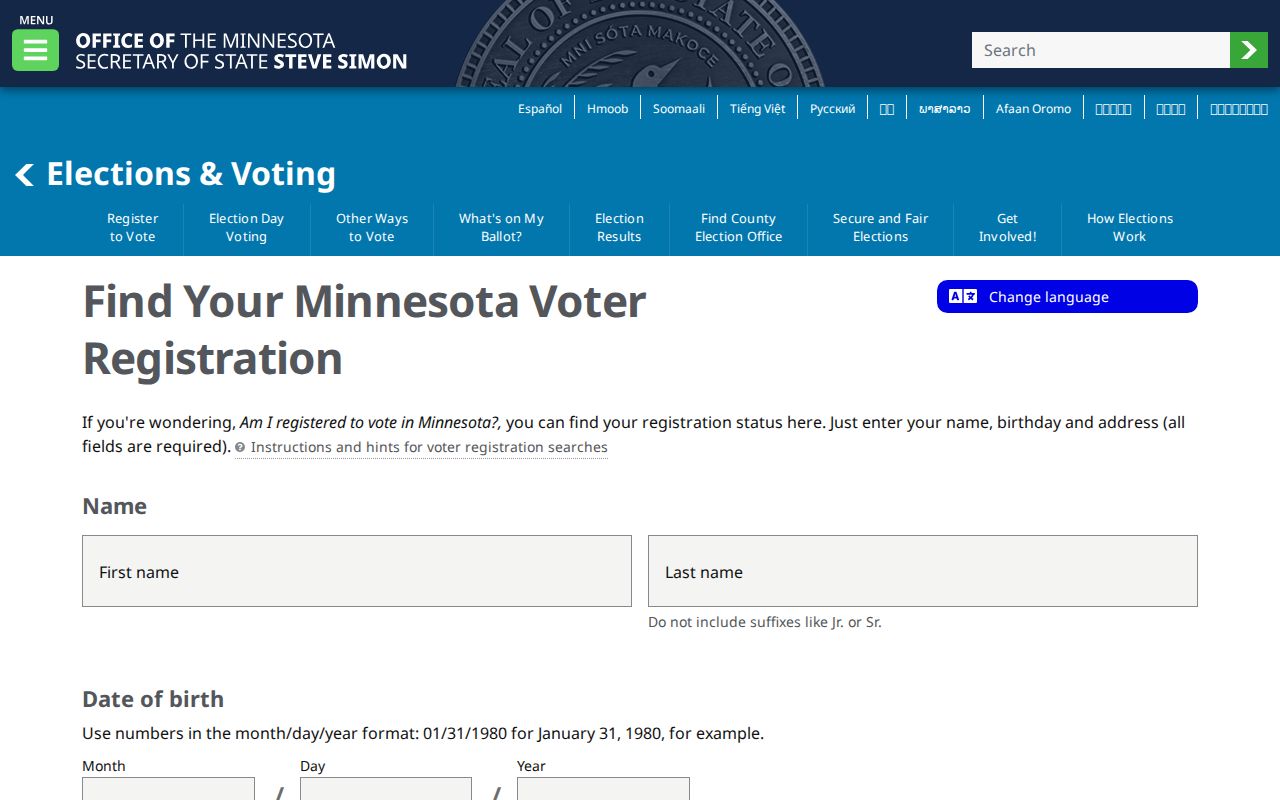
Treat the match screen as one dated registration clue, then corroborate it with the right property, court, or historical record.
Rosemount Court Name Checks
Minnesota Court Records Online, or MCRO, is the statewide gateway for Dakota District Court cases. Its name mode accepts last, first, and middle names. A wildcard after two characters is supported, along with a Sounds Like option. Searchers can also filter by date of birth, filing date, category, status, county, or court. Case-number, citation-number, and attorney modes sit on separate tabs. A name match is not a certified record. A category label does not settle an outcome either.
A typical result opens the case number, category, status, and filing date. Parties, court location, and hearing information follow. The Register of Actions, judgment detail, and public document links come with them. Sealed, juvenile, expunged, and other confidential material stays limited online. For certified copies or a file needing local access, contact Dakota Court Administration. The web page alone is not final proof. MCRO's public search holds the interface.
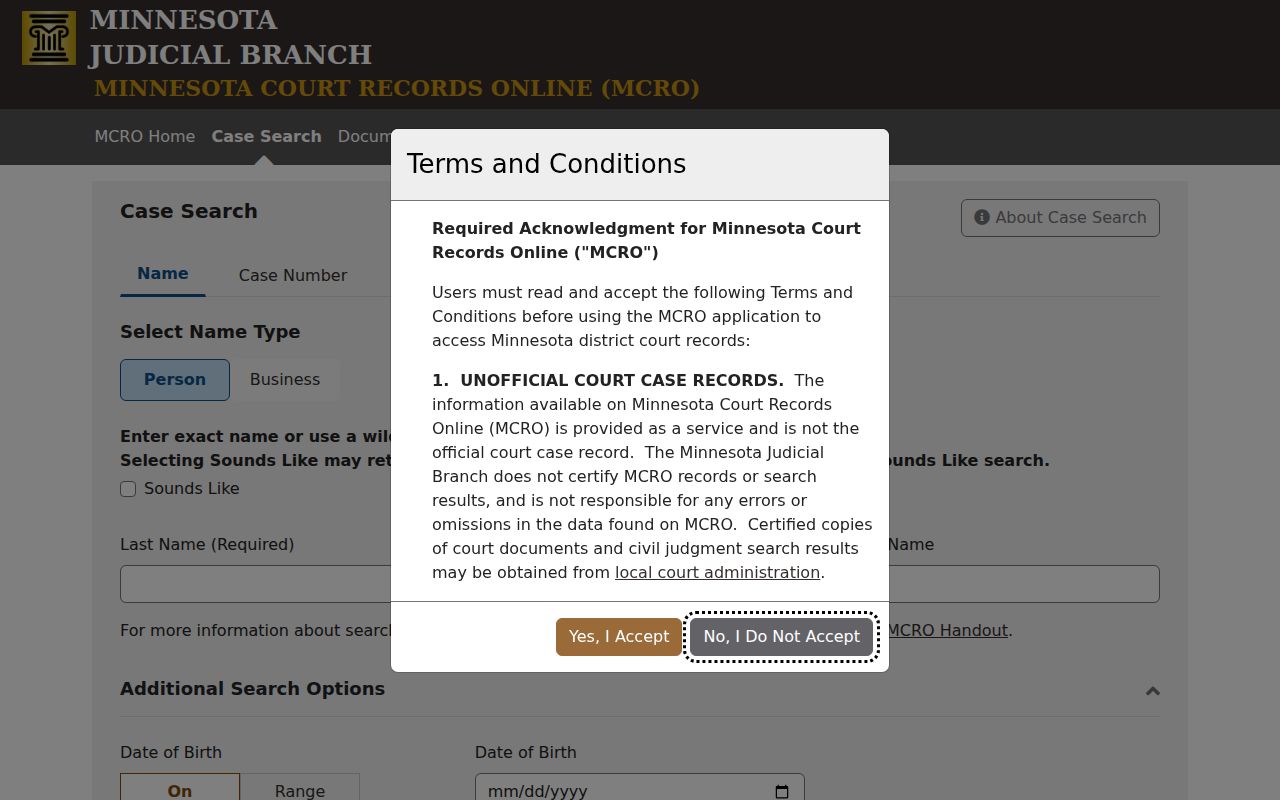
The tabbed search helps narrow a Rosemount court question. Still, identifiers beyond a shared name remain essential, because a common surname can pull unrelated cases from across the county into one result set.
Current Rosemount Resident Directories
Current Rosemount resident records are purpose-built lists, not one master directory. The property portal takes an address-first route. It returns parcel owner and taxpayer information. MNVotes confirms a registration match only when all required details line up. MCRO names case parties. It also tracks case activity. A city staff directory lists current municipal contacts.
State business and licensing databases can identify a filing or a professional affiliation. But an office address, agent, or business listing is not proof of where someone lives.
| Rosemount record source | What it can show | Custodian | Access route |
|---|---|---|---|
| Property Information | Parcel owner or taxpayer, situs and mailing addresses, tax and legal facts | Dakota County PT&R | Free address or PID search |
| Registration match | Whether supplied registration details match | Minnesota Secretary of State | Known name, DOB, and address |
| RecordEASE | Grantor, grantee, document and title-event information | Dakota County recorder | Account or paid search, counter fallback |
| City staff directory | Current staff name, title, email, and phone | Rosemount | Category, first-name, or last-name search |
| Civic and historical collections | Opt-in organization context or historical names | Rosemount groups and Lawshe | Public page or staff-assisted research |
A name-and-identity question belongs with the Rosemount resident lookup workflow. An address question starts with the parcel system instead. Both routes need care. An entity party, an old mailing address, or a same-name court entry can look convincing without being the person or household sought.
| Official Rosemount source | Commercial people-finder category |
|---|---|
| Identifies a custodian, field set, access date, and record limits. | May combine old filings, marketing data, and stale address history. |
| Provides a correction or certified-copy route where available. | Cannot certify a government record or replace its custodian. |
| Lets a reader match the record to a narrow question. | Can merge same-name people or confuse a mailing relationship with residence. |
Rosemount Deed and Parcel Trails
RecordEASE is the county's recorded-document service. Dakota County describes searches by grantor or grantee name. It also covers legal description, document type, and recorded placement after login. The service separates Abstract from Torrens records. Its online status is useful but narrow. Abstract indexing is described back to July 8, 1993. Yet the county publishes no precise point where historical indexing turns incomplete. Older document images may still exist by book and page. Even a name search can fall short of them.
Start from a Rosemount address. Work to the property PID and legal description before any title search. Then record the grantor, grantee, and instrument type. Add the document number or book and page, recording date, and Abstract or Torrens tag. A party could be a trust, lender, estate, representative, or business rather than a person. The recorder counter and mail route remain the fallback. They cover anything not available in the online account. Dakota County RecordEASE holds the authenticated entry point for recorded-document research.
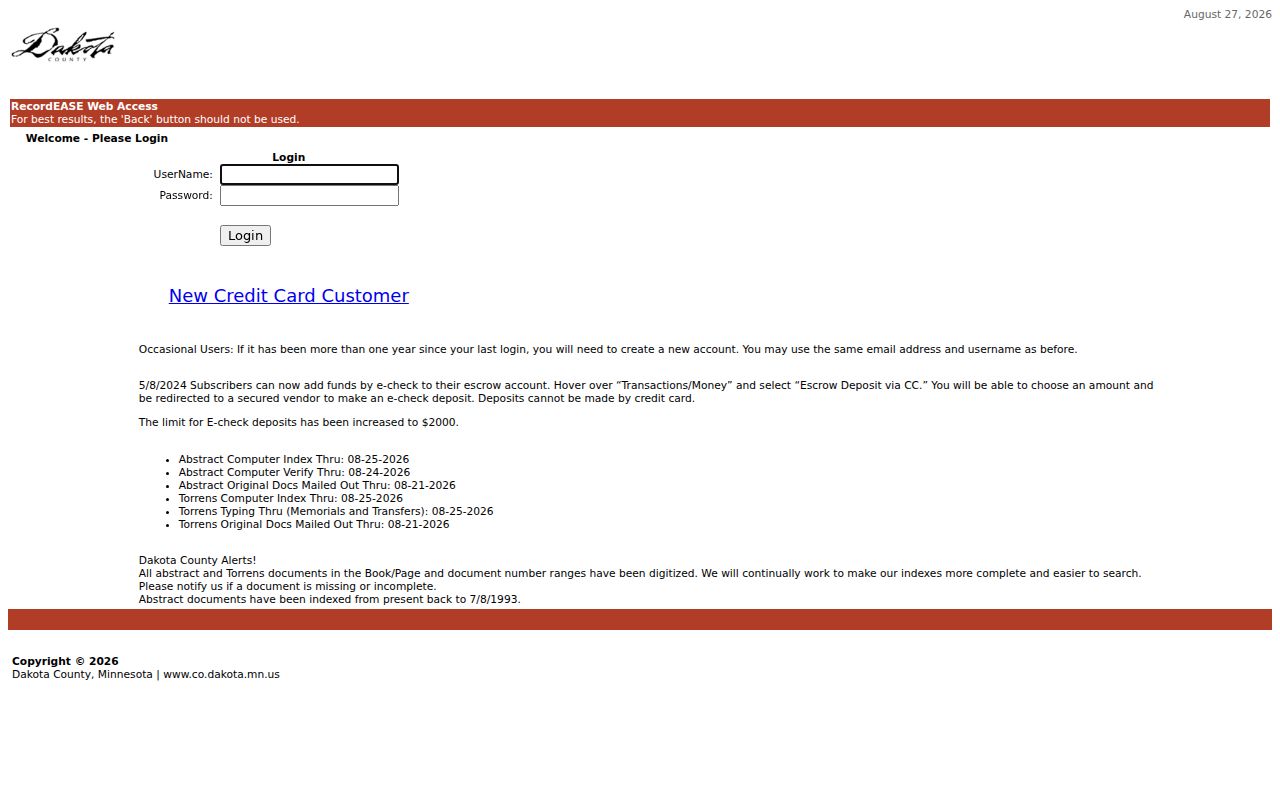
That login screen is a fair warning. A title trail is not the same as a free, complete historic name directory, and treating it like one leads to gaps.
Rosemount Vital Record Routes
Birth, death, marriage, and divorce records do not share one Rosemount custodian. The Minnesota Department of Health handles statewide birth and death guidance. Dakota County deputy registrar locations include the Robert Trail License Center in Rosemount. Marriage certificates come from the county that issued the license. A divorce decree comes from the district court that granted it. Certified copies carry statutory application, identity, and eligibility requirements. Minnesota applies no single rule. No fixed span of years makes every older vital record open.
Death information has a broader noncertified route than certified copies. Birth records can be public or confidential depending on classification and statutory exception. For family-history work, use the exact form and custodian. A name in an index does not guarantee access to a record image. Dakota County's local death route covers Minnesota deaths from 1997 forward. It also covers earlier deaths for people who lived or died in the county, subject to the applicable process.
Rosemount Business Record Context
Minnesota Secretary of State business and lien services can tie a person to an entity filing. They also cover an assumed name, UCC record, registered agent, office, or document history. That is an affiliation trail, not an address confirmation. Check the filing date and the person's role first. Then turn to the county or city custodian for the underlying question. The same caution fits a professional license. It may show status or discipline without establishing a personal residence. Minnesota business and lien services is the official entry point for entity and UCC material.
A filing can explain a business connection clearly. Even so, the role and mailing address must stay separate from any claim about a Rosemount household.
Historical Rosemount Resident Directories
Older Rosemount households start at Lawshe Memorial Museum, the strongest documented local resource. Its research library combines Dakota County newspaper microfilm with federal census holdings covering 1849 to 1940. Plat maps trace ownership from 1879 forward. Obituary and cemetery files, naturalization papers, Catholic records, city and township files, telephone books, city directories, oral histories, and photographs fill out the shelves. The museum publishes no complete year-by-year directory shelf list, so ask staff to pinpoint the title, its coverage, and whether a volume carries alphabetical, street, reverse, or criss-cross sections.
A genuine specimen survives in an 1880–81 Minnesota/Northwestern gazetteer. It sketches a village of roughly 200 people. Businesses, trades, and civic roles fill its columns. Household-by-household listings and modern street addresses were not its business. Old names also surface in newspaper notices, census pages, plats, church records, obituaries, and deeds. The Rosemount city directory page covers the full collection and how to read an entry.
A failed exact-name search proves little. Early initials, abbreviations, and OCR variants hide many entries. Preserve the spelling each volume actually uses.
Rosemount Records Across Time
Rosemount's record landscape spans two very different worlds. The 1880–81 gazetteer counted about 200 residents. The Rosemount Area Historical Society's 2023 figure is 27,590. That scale change explains why an old address may now sit near a subdivision, a park, an institutional tract, or a different civic description. The village was laid out in 1866. Township and village merged in 1971. Rosemount became a statutory city in 1975.
Historic descriptions may cite a township, a post office, a road variant, section-township-range, or lot and block instead of the present situs string. No citywide street-renumbering project exists on record. Bridge an old reference with a plat, the legal description, and the county parcel map rather than inventing a modern equivalence.
Rosemount Protected Record Limits
Minnesota places real limits on public access, and they matter in any resident search. Safe at Home participants keep a designated address under Minn. Stat. ch. 5B, which shields their real address from ordinary public-record searches. The public voter list omits protected addresses and other private identifiers. Utility customer and driver-record addresses are not general resident-search tools. Under the Minnesota Government Data Practices Act, a custodian may release public data. Private portions get redacted in that release.
Request paths run through specific custodians. Ask the city for a city record. Go to Dakota County PT&R for parcel or recorder questions. Court administration handles court files, and each election or vital-record custodian follows its own process. Never use a public record to stalk, harass, threaten, or harm anyone.
Rosemount Status Search Limits
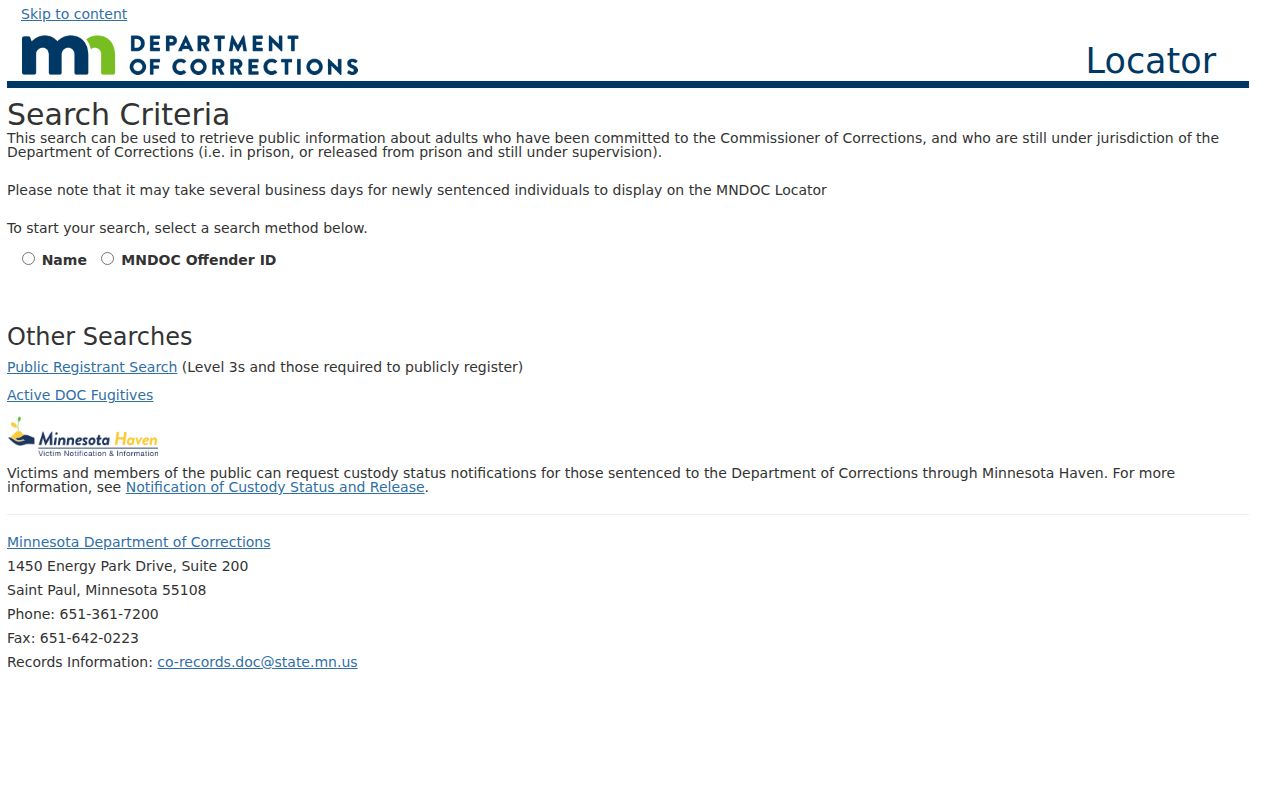
Corrections and public safety tools answer narrow, time-sensitive questions, not a Rosemount resident roll. Dakota County's jail search reflects current custody only. Minnesota DOC's public search covers adults under DOC jurisdiction. Search works by name prefix or exact six-digit ID. Court, jail, DOC, and registry results do not substitute for one another. A name match alone never settles identity.
Minnesota DOC's public viewer displays the state's adult-offender search interface along with its public-information warning.
Write down the access date. When identity matters, confirm it through the custodian, and never treat a charge or status label as a finding about a person.