
Rosemount Resident Lookup Records
A Rosemount resident lookup needs a record matched to the question. Dakota County Property Information begins with an address or parcel ID, so it is useful when a location is already known. The state voter tool is a match check with required identity and address fields, not a browseable roster. MCRO supplies statewide court information by searchable identifiers, while vital-record offices have separate access rules for each kind of event. Treat each result as a dated record from its own custodian. A matching name alone is not enough to combine unrelated results.
| Record | What It Confirms | Where | Access |
|---|---|---|---|
| Property and tax roll | Parcel owner or taxpayer, situs, mailing address, and legal description | Dakota County Property Information | Free address or PID search; not a household list |
| Recorded documents | Deed parties, legal description, and title events | Dakota RecordEASE | Login and paid-image limits apply |
| Registration match | Whether supplied registration details match | Minnesota voter lookup | Known-name, birth-date, and address check |
| Court record | Case information, filings, hearings, and public documents | MCRO | Free web search; restricted and sealed material is absent |
| Vital event | Birth, death, marriage, divorce, or parentage question | Minnesota vital records | Record type and eligibility control copies |
| Entity or license record | Public filing or credential connection | Minnesota eLicense | Agency-specific fields; not proof of residence |
Start from the strongest known identifier. An address can lead to a parcel result. A name with a supplied date of birth and address can be checked in the registration tool. A case number is stronger than a name-only court result. When a record points toward an official copy, keep the document number, case number, parcel ID, or exact filing date for the custodian.
Rosemount Voter Registration Match
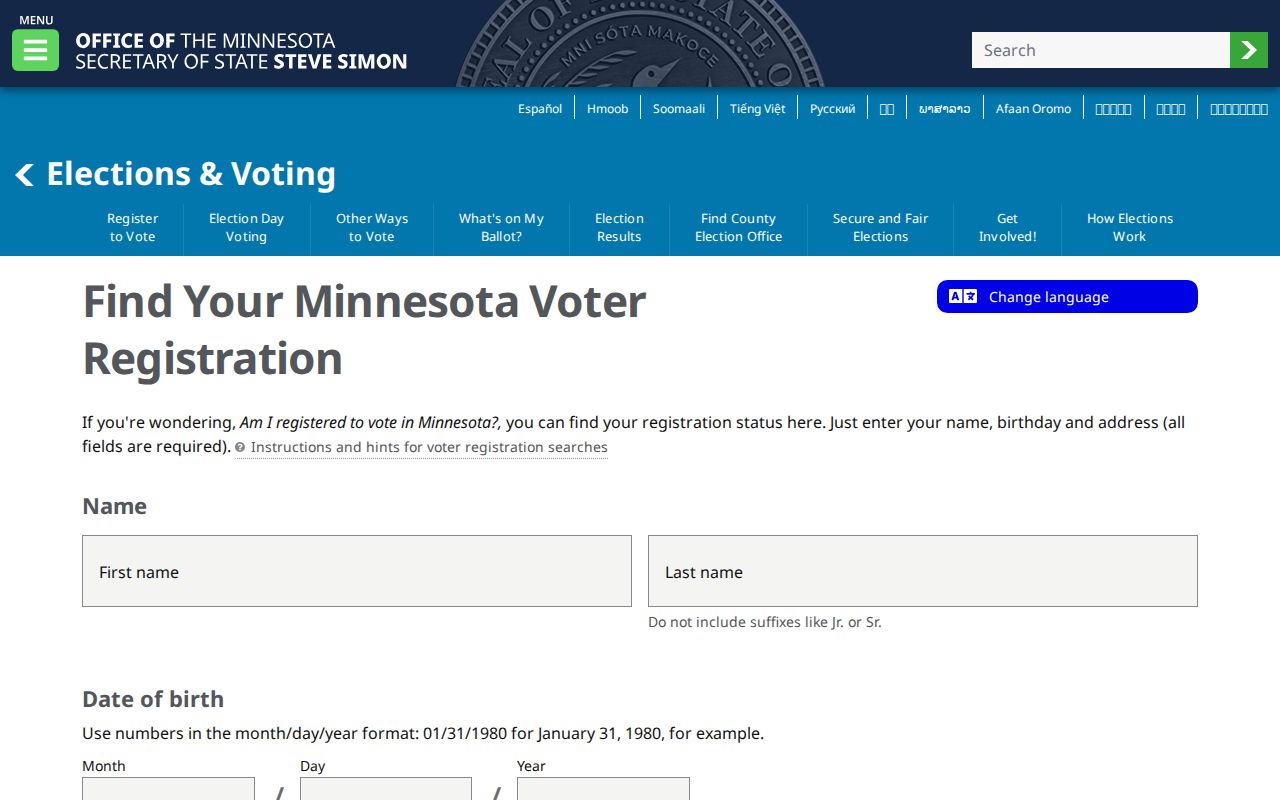
Minnesota's voter-registration lookup is a confirmation tool. It requires first name, last name, date of birth, and an address path. The address path can use a ZIP Code or Dakota County and city or township, then a house number and selected street. A unit field is available when needed. The system returns a match or nonmatch status and next steps. It is updated nightly, although a new application can take up to 14 days to process.
The MNVotes screen shows the required name, date, and address controls used for a Rosemount registration match.
A nonmatch does not establish that a person is not in Rosemount. A spelling variation, a recent move, address formatting, processing time, protected status, or a ZIP and city selection can change the result. The statewide public information list is a separate request process under Minn. Stat. § 201.091. It has statutory use limits and excludes full date of birth, government identification numbers, and protected addresses.
Do not use a registration result as a complete household roster. It confirms only the supplied match conditions. A taxpayer's mailing address and a voter address can also answer different questions.
Rosemount Resident Lookup in MCRO
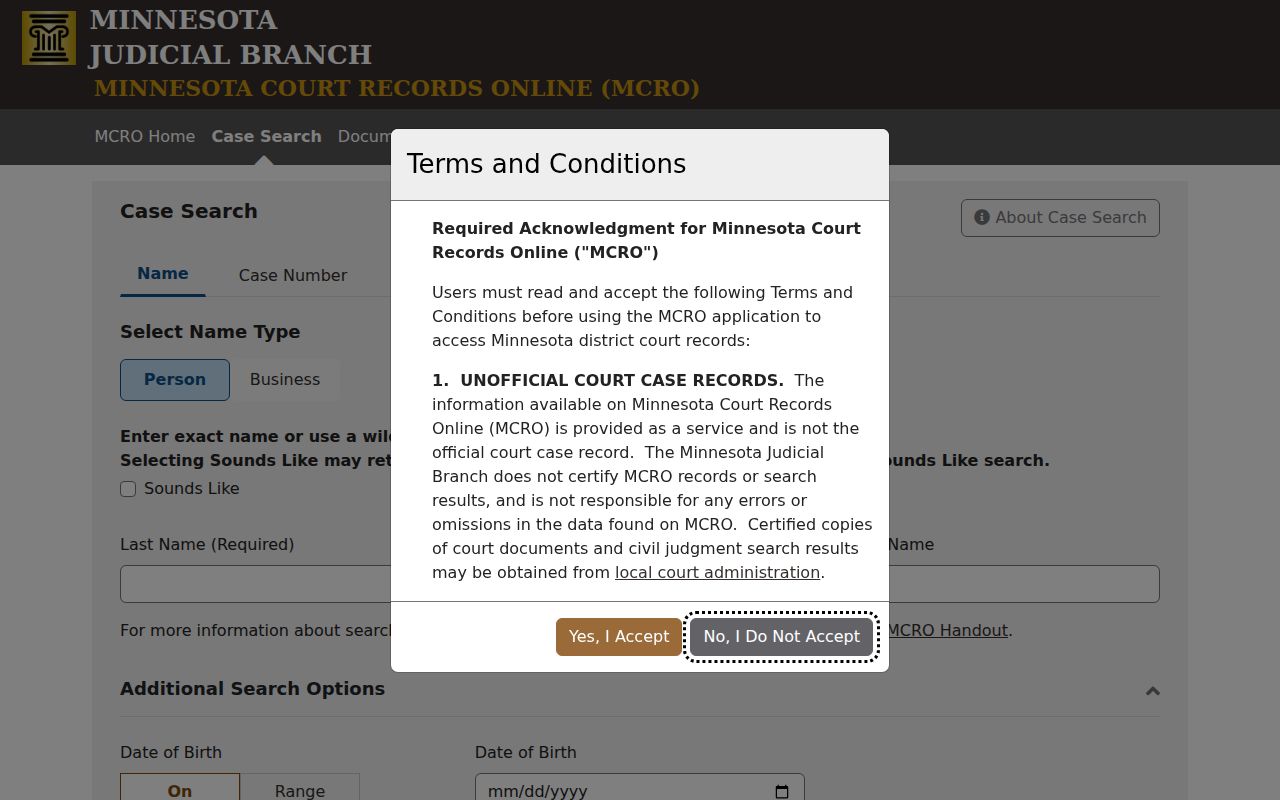
Minnesota Court Records Online, known as MCRO, is the free first pass for Dakota District Court and other Minnesota district-court cases. It can search by name, case number, citation number, or attorney. Name mode supports a trailing wildcard after two characters or a Sounds Like option, but those two methods cannot be combined. Narrow a same-name result with date of birth, filing-date range, case category, status, court location, and Dakota County where the facts support those filters.
| Name fields | Last, first, and middle name; exact spelling, trailing wildcard, or Sounds Like mode. |
|---|---|
| Date filters | Date of birth and date filed accept an exact date or a from-to range in MM/DD/YYYY format. |
| Case controls | Civil, Criminal, Family, Probate, or Mental Health category; status; statewide or county location. |
| Direct modes | Case number, citation number, and attorney search tabs offer an identifier-first route. |
| County filter | Browse or search counties, select Dakota, then execute the county search. |
The official MCRO search is the source for the captured form.
Search results may lead to case information, a Register of Actions, monetary-judgment details, hearings, and public documents. The display is not a certification. A case category is not an outcome, and a charge is not a finding. Read the Register of Actions and disposition before relying on a court result, especially when more than one person has the same name.
Verify Rosemount Resident Records
To look up a resident responsibly, keep the original spelling and establish one independent anchor before joining records. A property name may refer to an owner, taxpayer, trust, estate, lender, or representative rather than a person who lives at the parcel. Court records can have name overlaps. An obituary may use a nickname or former surname. The sound approach is a narrow comparison of at least two independent identifiers, such as a full name and known address, case number, event date, parcel ID, or recorded-document number.
- Normalize the name without replacing the original spelling. Test middle initials, hyphens, apostrophes, and lawfully known former names.
- When an address is known, open Dakota County Property Information and compare the situs, mailing address, taxpayer or owner field, legal description, and tax statement.
- Use MCRO with the available county, case number, date, or category detail. Read the Register of Actions rather than relying on the first result line.
- For a relevant vital event, use the appropriate county, court, or Minnesota health route and request a copy only through the eligibility process.
- Preserve the source URL, access date, and the limitation that remains. Direct a correction request to the custodian that created the record.
- Docket
- A court's running case record, often reflected through the Register of Actions, that tracks filings and events.
- Index versus image
- An index is a searchable list of record details; an image is the document view. Access to an image can differ from access to an index.
- Certified copy
- A custodian-issued copy authenticated for official use. It is different from an online display or an ordinary copy.
When two records disagree, do not force them together. Keep the conflicting field, date, and custodian in the research notes, then seek clarification from the office that maintains the original record.
Note: A name match becomes stronger only when a second independent identifier supports the same person and time period.
Rosemount Family Event Trails
Minnesota vital data does not use one universal closed-period rule. Under Minn. Stat. § 144.225, death data is generally available for informational, noncertified access, while certified copies require the statutory application and identity or eligibility checks. Birth records can be public or confidential depending on the particular record and statutory exception. Dakota County says certified death copies are available through its process for deaths anywhere in Minnesota from 1997 forward; earlier access depends on the county and event details. Marriage certificates come from the county that issued the license, while divorce decrees come from the court that granted the case.
An heir trail uses distinct sources for distinct facts. A Dakota probate case may identify a case path, an obituary may identify family context, a personal-representative deed can connect an estate transaction to a legal description, and a cemetery or parish file can provide a historical event clue. None should be silently converted into a current address. For former local context, the documented historical holdings are described on the Rosemount city directory collections page.
Parentage and adoption records use separate Minnesota health and court routes. A Recognition of Parentage can be sealed after a replacement birth record, and access depends on eligibility. There is no verified Rosemount-specific adoption registry or unofficial shortcut. Begin with the official Minnesota vital-record and adoption process when that is the actual record question.
Rosemount MCRO Counter Access
MCRO web access is useful but incomplete. Minnesota Rule 8.2 limits what appears online. MNPAC courthouse terminals can display some public information that is not placed on the web, including certain party street addresses or comments and categories of material excluded from name searches. Sealed, confidential, expunged, juvenile, and adoption material remains restricted. A case number can sometimes retrieve a result that a name search cannot, but it does not override a legal access limit.
Online documents are free when available, yet access before July 1, 2015 is very limited. Dakota Court Administration can retrieve off-site files. Uncertified copies have no fee in the cited guidance; certified copies may be requested in person, by mail, or with an eFile request form. Dakota's published example lists $14 for a certified civil or criminal instrument, certified imaged or e-filed printout, certified scan or picture, or certified screen print. Use the Minnesota court copy-request route for the current method and restrictions.
Rosemount State Status Records
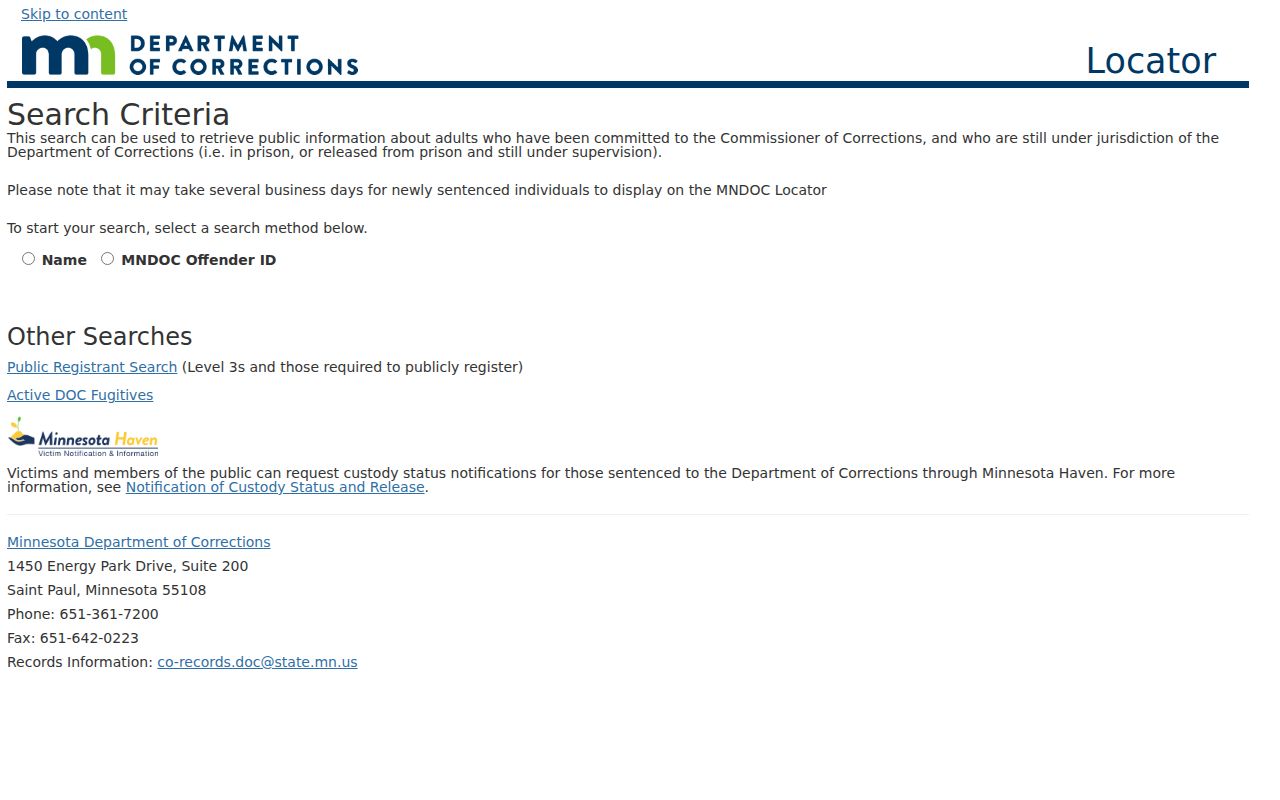
Some state searches are status-specific rather than resident directories. The Minnesota DOC public search accepts a first-name and last-name prefix or an exact six-digit MNDOC Offender ID. A result can show a name, date of birth, known aliases, ID, current status, highest-ranked offense, court file numbers, and status detail. It covers adults under DOC jurisdiction, and newly sentenced records can take days to appear.
The official Minnesota DOC search form is shown below.
A result is not a substitute for the underlying court disposition, and the absence of a result is not an identity conclusion. Date-stamp any status research, use only the minimum detail needed for a lawful purpose, and verify uncertain information with the primary custodian.
Rosemount Public Record Affiliations
A Minnesota Secretary of State filing, UCC record, or state license can connect a name to an entity, role, or filing address. It does not establish a current personal residence. The Secretary of State business and liens service searches entities and filings, while the eLicense landing page routes users to many separate state agencies. Board fields, update cycles, and access rules differ by source.
For local Rosemount license, special-event, or commission material, no public name-search city register was located. A focused request to the City Clerk should identify the category, date range, and record sought under the Minnesota Government Data Practices Act. Ask for public portions and expect required redactions rather than assuming a city list contains every person connected to an activity.
Rosemount Record-Check Limits
Minnesota's Government Data Practices Act begins with public access unless another law classifies the data differently. Minn. Stat. § 13.03 permits inspection at reasonable times and allows public portions to be requested from the responsible custodian. Copies can have actual-cost charges. A city request belongs with Rosemount's responsible authority, a property correction with Dakota County Property Taxation and Records, a court question with court administration, and a voter concern with the county or Secretary of State route.
Some information must stay protected. Safe at Home gives eligible Minnesota residents a designated address and mail-forwarding arrangement, and its real-address protections are not a general opt-out. The public voter list also withholds protected addresses and full dates of birth. Minnesota's consumer-data law does not erase the underlying official record. For any official correction, ask the agency to identify the data classification and correction process. Never request or publish the protected real address of a Safe at Home participant.
Lawful use. Rosemount records are for personal, lawful research. Minnesota's anti-stalking and harassment laws prohibit using public records to threaten, repeatedly contact, surveil, or expose another person.
Note: If a result seems wrong or outdated, preserve the record reference and seek correction from the office that maintains it.