
Rosemount Previous Residents by Era
Different records preserve different parts of a Rosemount address history. The parcel record and tax statement establish the modern land identity. Recorded documents extend the title trail, but a deed party may be a trust, estate, lender, business, or representative rather than a person who lived at the address. Directories, newspapers, and census schedules add people and household context when the title or date actually includes the address. The table keeps those evidence types separate and preserves the documented gaps.
| Source | Years It Covers | Where Held | What It Shows |
|---|---|---|---|
| Dakota abstract index | Indexed documents described back to July 8, 1993; earlier completeness unstated | RecordEASE and Dakota PT&R | Recorded parties, document type and number, date, legal description; image access can be gated. |
| Torrens index | Current operational status through August 2026; older book and page ranges digitized | RecordEASE and Dakota PT&R | Certificate and title-memorial history; exact earlier name coverage is not published. |
| Dakota tax statements | Current plus three prior years online | County Property Information | Taxpayer and property information, values, and legal description, not a continuous resident history. |
| Dakota plat maps | 1879 to present described in holdings | Lawshe Memorial Museum | Parcel ownership and subdivision context; exact map years need staff confirmation. |
| City directories and telephone books | Exact Rosemount shelf run not published | Lawshe Memorial Museum | Name, address, and occupation where a volume includes Rosemount; reverse coverage is unconfirmed. |
| Minnesota gazetteers | 1865 and 1878 to 1919 volumes located | Internet Archive, Google Books, and libraries | Town, business, and civic names, not a complete household list. |
| Federal census | 1849 to 1940 holdings described | Lawshe and federal routes | Household composition, ages, birthplace, occupation, and place context; address detail varies. |
| Newspaper microfilm | Back to the 1850s described | Lawshe Memorial Museum | Announcements, obituaries, legal notices, and community events; exact title run needs confirmation. |
| Permit records | Historical online start not located | Rosemount Community Development | Project, alteration, or inspection clues when requested by address and date. |
Start with the date you know. A recent title question belongs with the county parcel and RecordEASE routes. An older household question may need the legal description and plat before Lawshe staff can identify a useful directory or newspaper reel. No public Rosemount house-history portal or verified house-history guide was located, and no Rosemount Sanborn map edition was found. Those negative results are important because they prevent a false promise of a searchable historical address file.
Rosemount Previous Residents Parcel Identity
Before tracing past residents, fix the property in the Dakota Property Information viewer. Search a building number and street or a PID, then compare the map outline, situs address, tax description, and any subdivision information. The county says a PID may be entered with or without dashes. Its sample form, 34-02000-08-010, identifies a tax parcel and is not a street number. A map click is useful when a road has similar segments or a parcel has recently changed.
The situs address is the physical parcel location. The tax mailing address is where correspondence goes and can be somewhere else. A legal description is the land identity carried through deeds, plats, Abstract records, and Torrens records. The parcel result may show an owner or taxpayer, but that is not proof of every household member. These distinctions are the first protection against joining an unrelated tax contact or title party to a Rosemount past-resident record.
Rosemount’s village layout dates to 1866, and its government context changed when the township and village merged in 1971 and the place became a statutory city in 1975. No verified Rosemount-wide street-renumbering or renaming project was found. Where an older source uses a township, post-office label, Dodd Road reference, lot and block, or section-township-range wording, use the plat and legal description instead of inventing a modern street conversion.
Rosemount Previous Residents Deed Chain
A title chain gives the strongest backward route for a Rosemount address, but it is a chain of transactions rather than a ready-made occupant list. Dakota County RecordEASE documents a searchable family of grantor, grantee, legal-description, document-type, and date fields after authentication. The county distinguishes Abstract and Torrens systems. Most county parcels are Abstract, while a Torrens certificate consolidates title records subject to stated exceptions. Follow the exact parcel identity through either system.
- Save the current parcel record. Capture the PID, situs address, current tax or owner field, and full legal description from Dakota Property Information.
- Find the current purchase document. Search the current grantee and legal description in RecordEASE, then record the document number or book and page, date, instrument type, and title system.
- Turn the seller into the next search. The prior grantor from that transaction may appear as the earlier grantee for the same legal description.
- Repeat only with matching land identity. Check each candidate against the plat, recording date, legal description, and document type. Do not substitute a similar street address.
- Use the custodian when the online path ends. Ask the PT&R counter or mail channel for the needed book, page, or document, then compare it with Lawshe plat material for earlier context.
- Grantor / grantee
- The grantor transfers an interest in a recorded document. The grantee receives that interest. Either party can be an organization, estate, or representative.
- Chain of title
- A sequence of recorded land transactions for the same legal description. It tracks title events, not every person who lived there.
- Legal description
- The formal land description in a deed or plat. It is more stable than a street label when comparing older Rosemount records.
- Criss-cross directory
- An address-first directory arrangement, if the volume has one. Its exact Rosemount availability must be confirmed with Lawshe staff.
- Enumeration district
- The geographic area used by census takers. It helps place a household record when a historical street address is incomplete.
The county’s RecordEASE entry screen is the source for this image. A login is required for the post-login search experience, so its exact current result labels and sorting should be verified directly with PT&R.
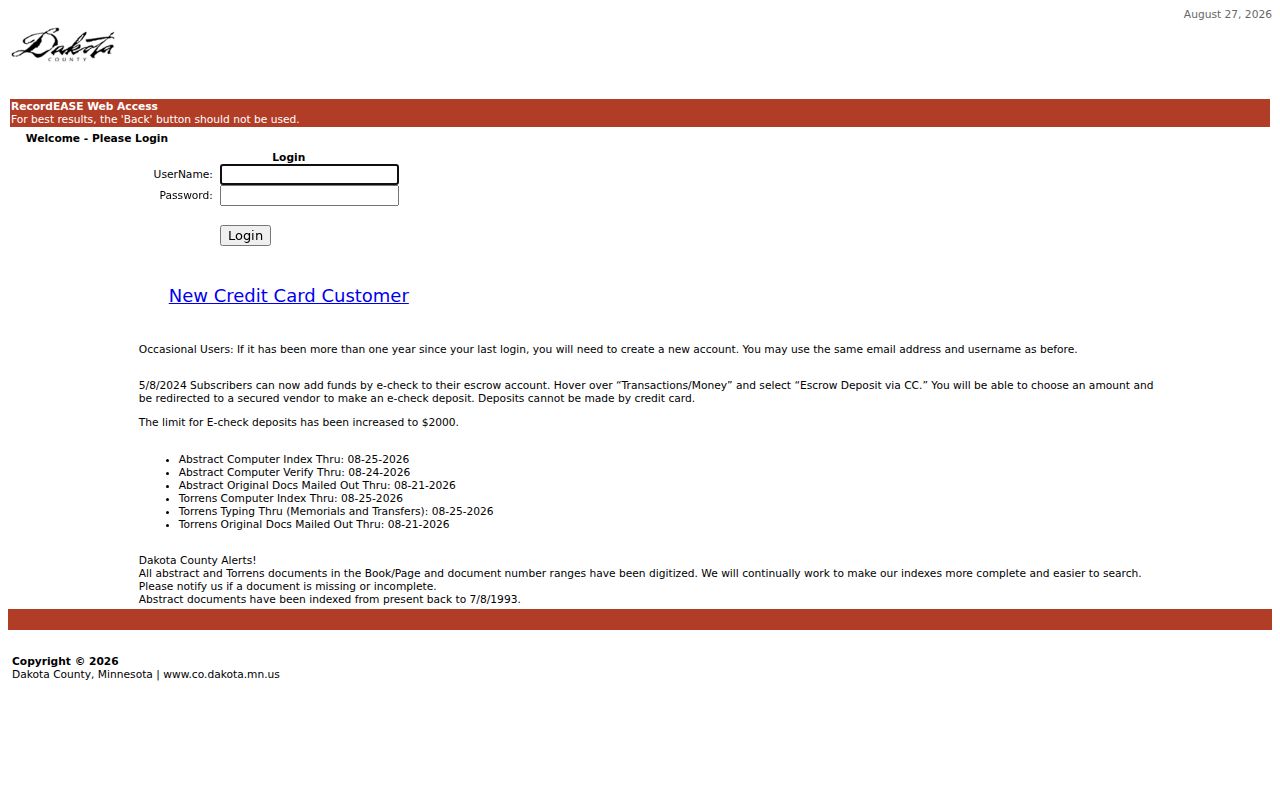
The visible sign-in screen marks the point where a confirmed address and legal description move into the recorded-document trail. Preserve both before relying on a party name.
Rosemount Previous Residents Index Dates
RecordEASE has two kinds of dates that answer different questions. The county describes abstract documents as indexed back to July 8, 1993, but also says its indexes continue to become more complete. That is not a promise that every earlier document is absent or that every document after that date has the same online path. The older title record may require a book and page search, a counter request, a mail request, or a plat check.
Operational status in August 2026 also differs by document process. The abstract computer index and Torrens index or typing displayed activity through August 20; abstract verification displayed August 19; and original documents mailed displayed August 17. These are recent processing markers, not opening dates for historic records. For a past-residents timeline, write the document’s actual recording date beside the portal status date so a fresh update is never mistaken for the date of a decades-old conveyance.
RecordEASE access is paid in several modes. The county lists occasional session, search, document, certificate, and tract-card prices, as well as a subscriber option. Its recorder office also accepts in-person and mail requests at the Hastings Administration Center, 1590 Highway 55, Hastings, with a cover letter, phone number, and self-addressed stamped envelope for mail work. That fallback is especially important when the index result needs a certified or better-identified copy.
Note: The point where online pre-1993 searching becomes incomplete was not published, so an empty result cannot prove a break in Rosemount title history.
Rosemount Previous Residents Archive Bridge
Lawshe Memorial Museum is the documented local bridge when the title chain becomes a household-history question. Its holdings include city directories and telephone books, newspaper microfilm, 1849 to 1940 federal census material, plat maps from 1879 forward, obituary and cemetery records, naturalization files, Catholic and local church material, oral histories, and photographs. The museum is at 130 3rd Ave N in South St Paul, and its phone is 651-552-7548. Research help is free for members; the published nonmember suggestion is $15 per half hour.
Ask a narrow question: which Rosemount or Dakota County directory, telephone book, reverse directory, newspaper reel, plat, or obituary file covers this address or surname in a stated year? Lawshe must confirm the exact title and shelf years. It is not accurate to claim a verified continuous directory run, a public reverse-directory database, or a dedicated Rosemount house-history portal. If a needed reel is elsewhere, Dakota County Library’s interlibrary loan route allows up to 12 requests and says most requests are filled within 30 days; microfilm readers are listed at Burnhaven, Farmington, Pleasant Hill, and Wescott.
The historical volumes and their formats belong with the Rosemount Directory Book. For a previous-residents search, use a matched address or legal description to ask for the one volume and year that can test the deed-chain hypothesis.
Rosemount Previous Residents Registration Clues
Lawshe’s listed holdings include 1918 alien-registration forms, an unusual Dakota County source that can add context to a historical person already tied to a Rosemount address. A form may supply a residence, birthplace, status, or other identifying detail. It is not a modern public browse tool and does not by itself prove that a person lived at a particular parcel. Use the form as a dated clue, then compare its spelling and place information with the deed, plat, directory, census, newspaper, or naturalization record that fits the same period.
Ask Lawshe Memorial Museum to confirm the exact access arrangement, index coverage, and whether the form collection contains a relevant name or place. Preserve a negative result as a collection limit rather than treating it as proof that a person was absent from Rosemount. The value of this record group is its ability to resolve an identity or date conflict in a prior-residents trail, not to replace the parcel identity established through Dakota County records.
Rosemount Previous Residents in Local Context
Older Rosemount records may describe a compact village, a township, a post office, or a farm landscape rather than the current city form. The 1971 township and village merger and the 1975 statutory-city change are useful geographic markers, but they do not create an automatic address conversion. Compare the road variant, plat, section, township, range, and nearby parcel before treating an old local label as the same modern address.
Local newspaper indexing can provide a valuable name and event trail. John Loch indexed Dakota County Tribune material from the 1880s for more than two decades. A Star Tribune account reported more than 106,000 entries and donation of the data to the Rosemount Area Historical Society. Current custody and access should be confirmed with the historical society, not assumed to be a complete online index. The same historical account includes Gopher Ordnance Works-era material, while Rosemount’s 150th-anniversary history map says the 1942 project displaced more than 90 farms and 858 buildings across nearly five townships.
That scale change explains why a past-resident trail can cross a farm, village address, institutional tract, or later subdivision. It does not identify a particular household. Newspaper notices, deeds, plats, church material, cemetery evidence, and census schedules remain separate pieces of evidence until their dates and geographic details agree.
Rosemount Previous Residents Household Trail
Once the parcel and title chain are stable, use directories and census records as a dated household layer. Lawshe describes city directories and telephone books but has not published the exact Rosemount runs or whether a needed volume is alphabetical, classified, reverse, or criss-cross. A directory entry can include a name, address, occupation, or telephone context. A federal census can add relationships, ages, birthplace, and place context. Neither source should be treated as if it were recorded on the same day.
- Choose a deed or plat date. Use it to set the time window and preserve the address form used at that moment.
- Request the closest directory or telephone-book title. Ask Lawshe whether the volume includes Rosemount and whether it has an address-first section.
- Capture the entry exactly. Record spelling, initials, abbreviations, address, page, and whether it is a person, business, or civic listing.
- Pair it with the nearest census year. Compare household relationship and location context, while keeping the different enumeration and publication dates visible.
- Close with independent evidence. Use an obituary, probate file, cemetery record, church record, or recorded transaction only when it fits the same person, place, and time.
The digitized 1880-81 Minnesota and Northwestern Gazetteer offers a Rosemount town and business snapshot. It has public-facing names and roles, not house numbers, a household list, spouse fields, or an owner and occupant marker.

The gazetteer supports historic place and name context, while the deed, plat, and address evidence are still needed to connect an entry to a specific Rosemount property.
Lawful use. Rosemount previous-resident research is for house history, family history, estate and heir matters, and personal curiosity. Do not use information from these records to stalk, harass, track, or harm a living person.